Archive for month: February, 2021

Healthcare Care Education Credits

Healthcare Compliance Symposium on April 22, 2021 Offers Multiple Learning Credits
The 4th annual Healthcare Compliance Symposium is a joint effort of Delaware Law School and First Healthcare Compliance to provide resources for professionals working to stay informed regarding the challenges of the complex and highly regulated healthcare industry. The virtual event will be held on April 22, 2021 from 11:30 am ET until 5:45 pm ET. Registration is available to the public with discounted pricing until March 1, 2021.

The New AKS and Stark Laws Final Rules – Key Take-Aways
Catherine Short converses with Rachel V. Rose, JD, MBA, principal with Rachel V. Rose – Attorney at Law, P.L.L.C., Houston, TX, on the topic of “The New AKS and Stark Laws Final Rules - Key Take-Aways.” On November 20, 2020, the Centers for Medicare and Medicaid Services (CMS) issued a Final Rule related to the Medicare Physician Self-Referral Law (Stark Law). Nearly simultaneously, the Office of the Inspector General, Department of Health and Human Services (HHS-OIG), released a Final Rule, which amends various safe harbors to the Federal Anti-Kickback Statute (AKS). The changes appear to be based, in large part, on value-based healthcare delivery and payment systems. On this episode, we will highlight the key changes, along with the similarities and differences in the language between the two Final Rules, examine the new AKS safe harbors and Stark Law exceptions, compare and contrast critical items found in both Final Rules, and appreciate the risks of non-compliance.
Q&A: The New AKS and Stark Law Final Rules – Key-Take-Aways

Q&A: The New AKS and Stark Law Final Rules – Key Take-Aways
Rachel V. Rose, JD, MBA, presented the webinar “The New AKS and Stark Laws Final Rules – Key Take-Aways” recently. Rachel returned to answer many commonly asked questions from the webinar.
E/M Coding Updates Podcast

E/M, CPT Code, & Documentation Updates for 2021 – CMS & AMA Come Together to Benefit Providers
Cindy Groux, CHBME/Board Member at HBMA and CEO, President and Owner of Health Care Practice Management, will address new CPT codes for 2021 to include prolonged services and clinical staff services, documentation changes to reduce the administrative burden, decreased needs for audits and how to promote coding consistency, and new rules for time billing.
HIPAA COVID-19 Updates Webinar

HIPAA in the time of COVID-19: Recent updates and enforcement actions
Rachel V. Rose, JD, MBA, principal with Rachel V. Rose – Attorney at Law, P.L.L.C., Houston, TX presents. Throughout the pandemic, HHS-OCR has announced the use of its enforcement discretion when bringing forth HIPAA-related enforcement actions. This trend appears to be continuing as the vaccine roles out. Additionally, proposed changes to the Privacy Rule were released in December 2020 and OCR continues to enforce violations against providers for not providing a patient with his/her medical records. This presentation provides a timely overview of these items, as well as addressing key terms such “reasonable” and “good faith” in the context of protecting the confidentiality, integrity, and availability of protected health information.
Big Data Webinar

Big Data & False Claims Act Risk Due to COVID-19
Stephen Bittinger, partner with K&L Gates in the firm’s Charleston office and a member of the health care/FDA practice group, is presenting with us on the brief history of use of big data in investigating and proving False Claims Act liability. He will offer an explanation of the government agencies and contractors involved in gathering health care data for investigation of fraud and abuse. We will look into the increased risk of fraud investigations due to regulatory changes implemented in response to COVID-19, and give practical ways to use data to reduce risk of investigation and liability.
New Stark AKS Podcast

HIPAA Business Associate Agreements Under HITECH

Rachel V. Rose, JD, MBA, principal with Rachel V. Rose – Attorney at Law, P.L.L.C., Houston, TX presents. “As part of the Department’s effort to fully protect patients’ health information and their rights under HIPAA, OCR has issued this important new fact sheet clearly explaining a business associate’s liability,” said OCR Director Roger Severino. In 2013, under the authority granted by the HITECH Act, OCR issued the Final Omnibus Rule that, among other things, identified provisions of the HIPAA Rules that apply directly to business associates and for which business associates are directly liable. One of the most notable items is the Business Associate Agreement. The presentation highlights enforcement actions, as well as key compliance items business associates and subcontractors need to focus on.
New Stark AKS Podcast

The New AKS and Stark Laws Final Rules Key Take Aways
Rachel V. Rose, JD, MBA, principal with Rachel V. Rose – Attorney at Law, P.L.L.C., Houston, TX presents on these new updates. On November 20, 2020, the Centers for Medicare and Medicaid Services (CMS) issued a Final Rule related to the Medicare Physician Self-Referral Law (Stark Law). Nearly simultaneously, the Office of the Inspector General, Department of Health and Human Services (HHS-OIG), released a Final Rule, which amends various safe harbors to the Federal Anti-Kickback Statute (AKS). The changes appear to be based, in large part, on value-based healthcare delivery and payment systems. The purpose of this presentation is to highlight the key changes, along with the similarities and differences in the language between the two Final Rules.
Data Analytics Podcast

Securing Your Data Analytics Program

Presented by Feisal Nanji, CEO and Executive Director at Techumen LLC. We are moving to a Data-based quality care where vast amounts of data move at high speeds with little to no governance of the data. This presentation will discuss key controls for data analytics, identify potential threats, and balancing risks versus rewards.

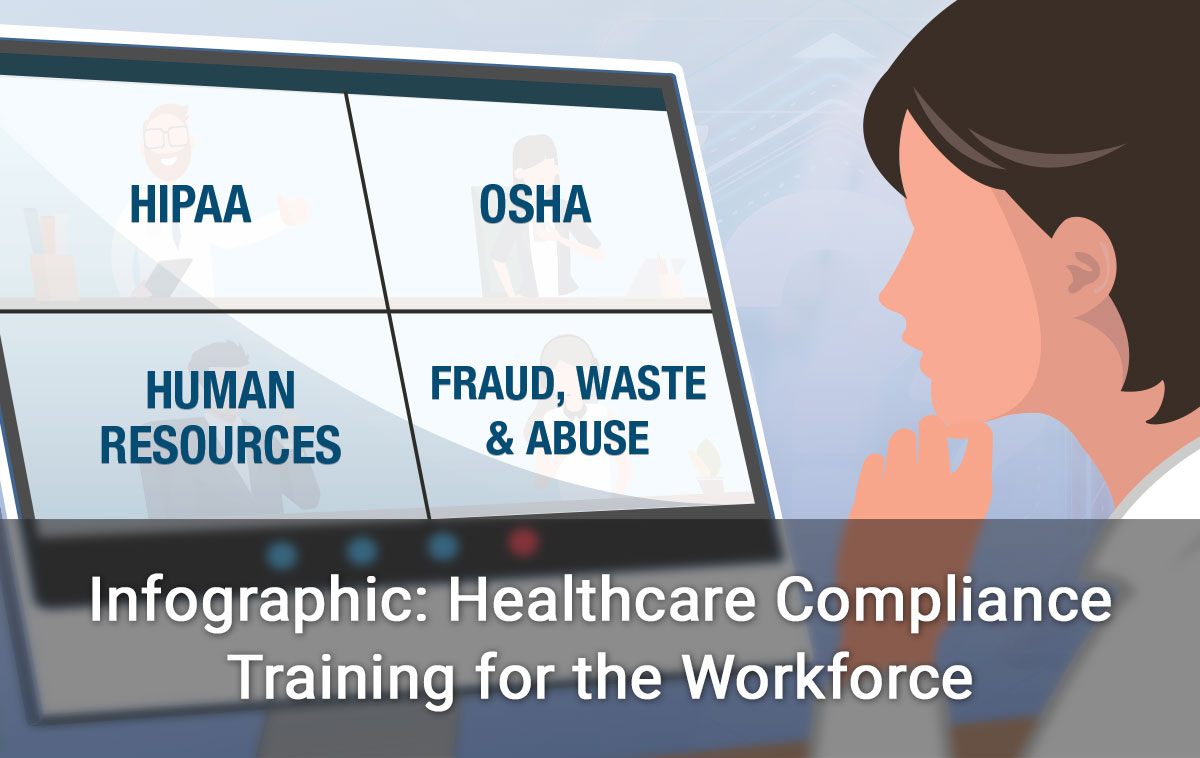
Infographic: Healthcare Compliance Training for the Workforce

Successful employee education is an integral part of a comprehensive healthcare compliance program. Compliance professionals must consider which topics should be offered to the workforce. Of course, proper training depends on variables such as type of healthcare organization, roles of employees and location of the entity. States may impose specific requirements that go beyond federal requirements. Generally, four broad categories cover the topics imperative to the start of a comprehensive healthcare compliance program.