

• Contact
  • 888-54-FIRST
  • Client Login
    • Client Portal
    • Online Store
Search
First Healthcare Compliance
  • Solutions
    • Compliance Management Software
    • Online Compliance Courses
    • Compliance Management Suite
  • Plans
  • Resources
    • Blog
    • Virtual Education Hub
    • 1st Talk Compliance Podcast
    • Connect Magazine
    • Compliance Posters
    • Healthcare Compliance Books
    • Newsletter Signup
  • News & Events
    • Press Releases
  • Our Team
  • Request Demo
  • Menu Menu
  • Shopping Cart Shopping Cart
    0Shopping Cart

Blog

Meaningful Use Ends In 2016?

January 26, 2016/in 1st Healthcare Compliance, Blog, CMS, EHR, EHR interoperability, HIPAA Privacy Rule, Meaningful Use, medical records, PHI, Uncategorized

Due to the challenges of implementing Meaningful Use, it is unsurprising the Center for Medicare and Medicaid Service (CMS) is finally rethinking the plan.  The goal of Meaningful Use (MU) to achieve nationwide electronic health record (EHR) interoperability and ultimately improve overall healthcare remains intact. Until further details and a formal announcement, certain steps will be necessary.
CMS administrator Andy Slavitt’s following announcement at the J.P. Morgan Healthcare Conference on January 12, 2016 gave some insight into the future of the program: “Now that we effectively have technology into virtually every place care is provided, we are now in the process of ending Meaningful Use and moving to a new regime culminating with the Medicare Access and CHIP Reauthorization Act (MACRA) implementation. The Meaningful Use program as it has existed, will now be effectively over and replaced with something better.”

Details are to be announced over the next several months but the focus will include:

  • Rewarding providers for patient outcomes not use of technology;
  • Customizing goals for provider’s practice, user-centered and supporting not distracting physician;
  • Requiring open API’s to get data in and out of EHR securely; and
  • Focusing on interoperability and engaging patients in their care.

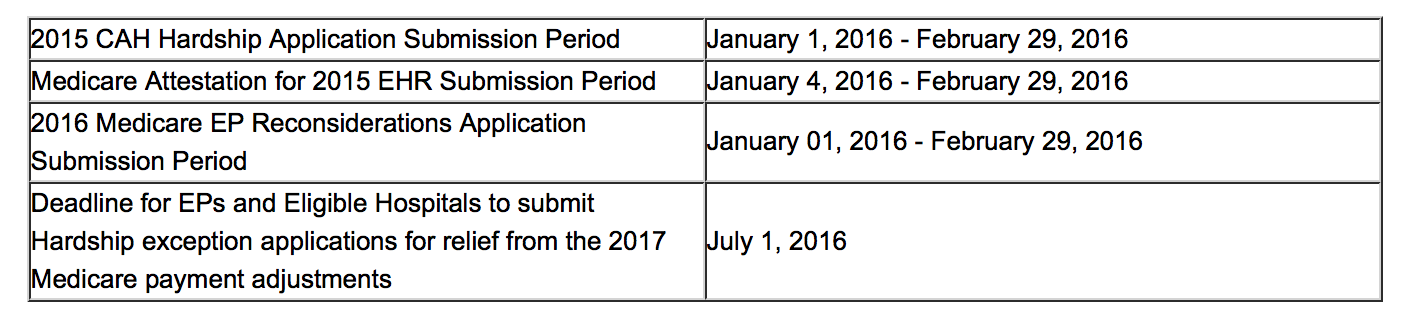
While waiting for further details and a formal announcement from CMS, deadlines will still need to be met for Meaningful Use.
Screen Shot 2016-01-25 at 2.27.06 PM

What is EHR interoperability?

EHR interoperability is the ability to exchange medical and treatment information from provider to provider with the receiving provider’s EHR integrating the exchanged information into their system. Specifically, providers should be able to:

  • View results from diagnostic procedures conducted by other providers to avoid duplication;
  • Evaluate test results and treatment outcomes over time regardless of where the care was provided to better understand a patient’s medical history;
  • Share a basic set of patient information with specialists during referrals and receive updated information after the patient’s visit with the specialist to improve care coordination;
  • View complete medication lists to reduce the chance of duplicate therapy, drug interactions, medication abuse, and other adverse drug events; and
  • Identify important information, such as allergies or preexisting conditions, for unfamiliar patients during emergency treatment to reduce the risk of  adverse events.

Ongoing Challenges of Meaningful Use

What are the obstacles preventing Meaningful Use from improving the quality and efficiency of healthcare and patient safety? A study by the Government Accountability Office (GAO) in September 2015 outlined the 5 biggest challenges to the success of EHR interoperability:

  • Insufficiencies in health data standards;
  • Variation in state privacy rules;
  • Accurately matching patient’s health records;
  • Costs associated with interoperability; and
  • Need for governance and trust among entities such as agreements to facilitate sharing information.

A data format standard for EHR, Consolidated Clinical Document Architecture (C-CDA) has been used by most of the health information technology industry however the methods of implementation and use of terminology are varied. Due to this variation, the receiving provider’s EHR may not be able to view the information exchanged.

Even more problematic are state regulations. Some states do not allow for automatic sharing in the health information exchange. A patient must consent to opt in or in some states patients are permitted to opt out. Additional consent requirements that are state-specific for sensitive information such as HIV or mental health records may not be adequately separated from the remainder of the record to avoid disclosure. These state specific variations would be difficult to navigate for complete EHR interoperability.

Accurately matching patient records may be difficult if the demographic identifiers used are varied amongst providers. In the case of similar demographic information among patients such as name, specific criteria will need to be met to accurately distinguish these individuals.

Cost still remains a major problem for the providers to achieve interoperability. Additional fees may be necessary for customized interfaces and any legal fees would also be the responsibility of the providers.

Organizational policies on privacy, security, data use and technical standards may vary between entities. Addressing these policy differences would be necessary to facilitate information sharing between entities.

Share this
  • Share on Facebook
  • Share on X
  • Share on LinkedIn
  • Share on Reddit
  • Share by Mail
https://1sthcc.com/wp-content/uploads/2015/02/Slide1_b.jpg 320 424 First Healthcare Compliance Staff https://1sthcc.com/wp-content/uploads/2022/10/1sthcc-logo-1024x378.jpg First Healthcare Compliance Staff2016-01-26 11:53:382025-04-15 12:58:03Meaningful Use Ends In 2016?

Subscribe to Weekly eNewsletter

Get the latest healthcare compliance updates straight to your inbox.

Subscribe to Newsletter

Recent Posts

  • OSHA Recordkeeping in Healthcare: Answers to Frequently Asked Questions
  • Naughty or Nice? The Rules of Giving and Receiving in Healthcare
  • fraud waste abuse healthcare compliance
    FWA in Healthcare: How to Respond Appropriately to Detected Offenses
  • Infographic: 6 Areas of Potential Liability for Healthcare Providers
    6 Areas of Potential Liability for Healthcare Providers
  • 5 Benefits of Automating Incident Reporting in Healthcare
  • Compliance Primer Series: Fraud, Waste and Abuse


First Healthcare Compliance is a division of Panacea Healthcare Solutions. Learn more

Subscribe

Get the latest healthcare compliance updates straight to your inbox.

Subscribe to Newsletter

Connect

Get started: Request Demo

Call: 1-888-54-FIRST

E-mail: Contact us

  • Link to Instagram
  • Link to Youtube
  • Link to Facebook
  • Link to LinkedIn
  • Link to X
© Copyright 2026 Panacea Healthcare Solutions, LLC | Disclaimer | Privacy Policy and Copyright Notice
Scroll to top Scroll to top Scroll to top

We and our third-party partners use cookies to improve and personalize your experience on the site and with our services in addition to delivering and reporting on ads. Please visit our Privacy Statement for more information. By continuing to browse the site, you are agreeing to our use of cookies. Read Privacy Statement.

OKDismiss

Cookie and Privacy Settings


How we use cookies

We may request cookies to be set on your device. We use cookies to let us know when you visit our websites, how you interact with us, to enrich your user experience, and to customize your relationship with our website.

Click on the different category headings to find out more. You can also change some of your preferences. Note that blocking some types of cookies may impact your experience on our websites and the services we are able to offer.

Essential Website Cookies

These cookies are strictly necessary to provide you with services available through our website and to use some of its features.

Because these cookies are strictly necessary to deliver the website, refusing them will have impact how our site functions. You always can block or delete cookies by changing your browser settings and force blocking all cookies on this website. But this will always prompt you to accept/refuse cookies when revisiting our site.

We fully respect if you want to refuse cookies but to avoid asking you again and again kindly allow us to store a cookie for that. You are free to opt out any time or opt in for other cookies to get a better experience. If you refuse cookies we will remove all set cookies in our domain.

We provide you with a list of stored cookies on your computer in our domain so you can check what we stored. Due to security reasons we are not able to show or modify cookies from other domains. You can check these in your browser security settings.

Other external services

We also use different external services like Google Webfonts, Google Maps, and external Video providers. Since these providers may collect personal data like your IP address we allow you to block them here. Please be aware that this might heavily reduce the functionality and appearance of our site. Changes will take effect once you reload the page.

Google Webfont Settings:

Google Map Settings:

Google reCaptcha Settings:

Vimeo and Youtube video embeds:

Privacy Policy

You can read about our cookies and privacy settings in detail on our Privacy Policy Page.

Privacy Policy and Copyright Notice
Accept settingsHide notification only