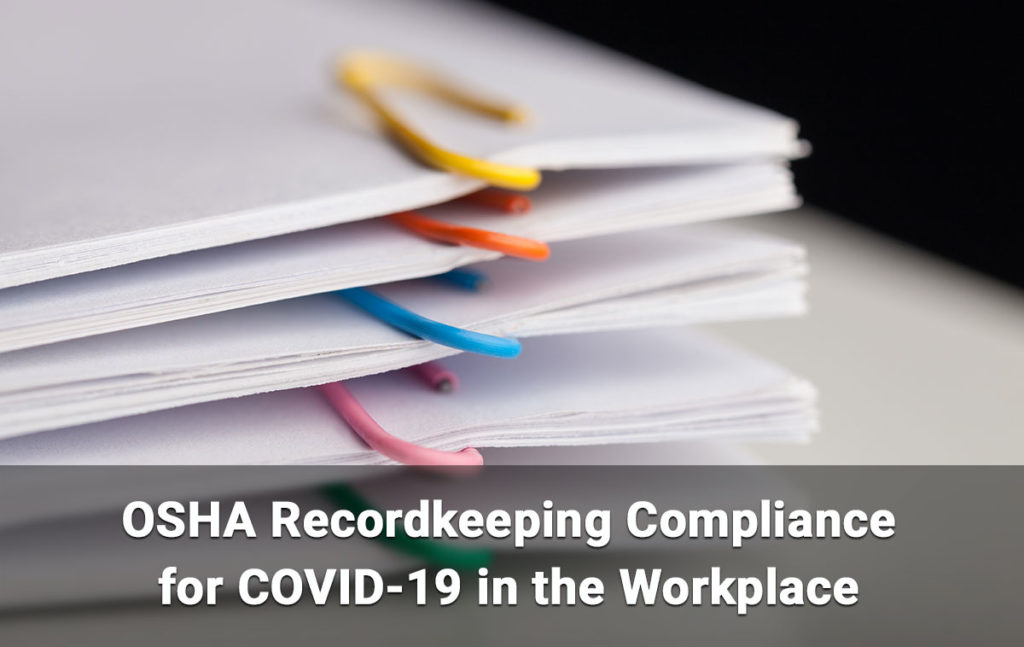
OSHA Recordkeeping Compliance for COVID-19 in the Workplace

Under the Occupational Safety and Health Administration (OSHA) recordkeeping regulations, employers are mandated to record serious occupational injuries and illnesses on the OSHA 300 Log. COVID-19 is a recordable illness if a worker is infected as a result of performing their work-related duties but how does an employer determine this? Given the nature of the COVID-19 pandemic and the difficulty in determining whether transmission of COVID-19 occurred in or outside the workplace, OSHA issued guidance to its Compliance Safety and Health Officers (CSHOs) in order to evaluate employers’ efforts in determining work relatedness of COVID-19 cases. The guidance clarifies employer obligations and provides a framework for employers to follow when facing a COVID-19 case in the workplace.
When to Record and Report COVID-19 Cases
Under OSHA’s regulations, employers must record a work-related COVID-19 illness if all of the following apply:
- The case is a confirmed case of COVID-19, as defined by the Centers for Disease Control and Prevention (CDC) (an individual with at least one respiratory specimen that tested positive for SARS-CoV-2, the virus that causes COVID-19);
- The case is work-related as defined by 29 CFR § 1904.5 (an event or exposure in the work environment either caused or contributed to the COVID-19 illness); and
- The case involves one or more of the general recording criteria set forth in 29 CFR § 1904.7( if it results in any of the following: death, days away from work, restricted work or transfer to another job, medical treatment beyond first aid, loss of consciousness, involves a significant injury or illness diagnosed by a physician or other licensed health care professional).
Note that there are two classes of employers that are partially exempt from OSHA’s recordkeeping requirements–employers with 10 or fewer employees and certain employers in low hazard industries (including physicians offices, dentists offices, other health practitioners offices, outpatient care centers, medical and diagnostic laboratories).
All employers, including those partially exempt, must report the following severe injuries to OSHA:
- report a COVID-19 illness that results in an in-patient hospitalization, amputation, or loss of an eye within twenty-four hours;
- report COVID-19 fatality within eight hours.
Determining if a COVID-19 Case is Work Related
Once an employer has knowledge of a COVID-19 case, the employer is obligated to take the following steps to determine if it is a recordable work-related illness:
Conduct a reasonable investigation into work-relatedness– OSHA’s guidance states that employers are not expected to undertake extensive medical inquiries, given employee privacy concerns. In conducting a reasonable investigation, in most cases it is sufficient for the employer to:
- Ask the employee how he/she believes the COVID-19 illness was contracted;
- Discuss the employee’s work and out-of-work activities that may have led to the COVID-19 illness, while respecting the employee’s privacy; and
- Review the employee’s work environment for potential SARS-CoV-2 exposure; the review should be informed by any other instances of workers in that environment contracting COVID-19 illness.
Consider all evidence available to the employer– OSHA expects the employer to consider the evidence that a COVID-19 illness was work-related based on the information reasonably available to the employer at the time it made its work-relatedness determination. If the employer learns of additional information related to an employee’s COVID-19 illness at a later date then that information should be taken into account as well.
Consider evidence that a COVID-19 illness was contracted at work– In considering all the evidence, OSHA’s guidance states that certain types of evidence may weigh in favor of or against work-relatedness. Examples of evidence that weigh in favor of work-relatedness include:
- several cases develop among workers who work closely together and there is no alternative explanation;
- the illness is contracted shortly after lengthy, close exposure to a particular customer or coworker who has a confirmed case of COVID-19 and there is no alternative explanation; or
- the employee’s job duties include having frequent, close exposure to the general public in a locality with ongoing community transmission and there is no alternative explanation.
Evidence that weighs against work-relatedness include:
- the employee is the only worker to contract COVID-19 in his/her vicinity and the employee’s job duties don’t include frequent contact with the general public, regardless of the rate of community spread; or
- the employee, outside the workplace, closely and frequently associates with someone (such as a family member, significant other, or close friend) who 1) has COVID-19; 2) is not a coworker, and 3) exposes the employee during the period in which the individual is likely infectious.
If the employer cannot determine whether it is more likely than not that exposure in the workplace played a causal role with respect to a particular case of COVID-19, then according to the guidance, the employer does not need to record the COVID-19 illness.
In conclusion, OSHA’s guidance serves as a valuable resource for employers and provides the framework for conducting a reasonable and good faith investigation in order to comply with regulations and more importantly to keep workers protected from an outbreak. Use of incident reporting and management software helps track and manage these types of compliance investigations with real-time visibility. First Healthcare Compliance’s cloud based software solution offers these tools plus more when it comes to meeting your healthcare compliance needs. Visit our website to learn more about our comprehensive compliance management solution for healthcare providers and explore our blogs for informative articles.