
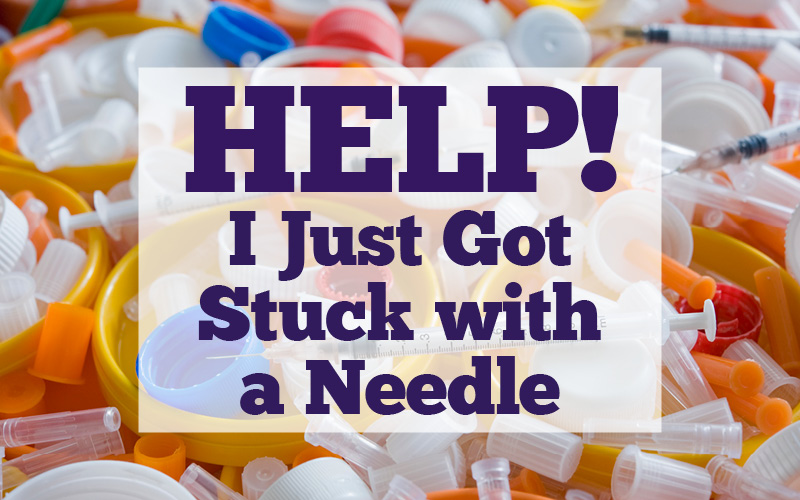
Help! I Just Got Stuck with a Needle
This is a phrase no one ever wants to hear, especially in a healthcare setting. When a distraught employee comes to you with a needle stick injury, what should you do as the employer? First and foremost, remain calm, which will alleviate some of the overwhelming anxiety your employee is already experiencing, and follow these simple steps:
- Treat The Exposure Site Immediately
- Document Exposure Incident on Exposure Incident Form
- The form should include details of the exposure incident such as type, route, and location of exposure along with relevant vaccination history of the employee and any protective controls that are in place (personal protective equipment or safer needle devices).
- Obtain Exposure Source status, if possible.
- Infectivity status of the source individual should be determined immediately, if possible. Don’t wait until an exposure incident occurs in your facility to find out if consent is required by your state laws to test the source individual. If the source status is already known, this might avoid unnecessary testing and need for consent. Any relevant source status data should be included on the Exposure Incident form, however the exposed employee must be reminded of the confidentiality of the source’s protected health information.
- Obtain Immediate Medical Treatment by a Licensed Healthcare Provider (HCP)
- Evaluation by a licensed HCP should be provided at no cost to the employee and without delay. The employer should provide a letter to the HCP with a copy of the Exposure Incident form and any other relevant medical information. Accompanying the letter should be a copy of the Bloodborne Pathogen Standard which outlines the requirement for obtaining a written opinion from the HCP, which must be provided to the employee within 15 days.
- Follow-up
- Depending on the HCP’s assessment of the exposure, post –exposure prophylaxis (PEP) may or may not be initiated. It is the employer’s responsibility to provide the employee with the HCP’s written opinion within 15 days of the evaluation. Additional follow-up should include counseling for the employee regarding: any possible ramifications of the exposure; reporting any possible exposure related illnesses or symptoms that may occur; and using any necessary protections for prevention of exposure to others. Appropriate OSHA Injury and Illness forms should be completed by the employer and submitted according to the newly revised OSHA Recordkeeping and Reporting Requirements.
What is the Risk from a Needle Stick?
Risk of transmission of infection due to a needle stick depends on many factors: viral load, length of time of the exposure, depth of the injury, use of a hollow- bore needle, type of fluid, presence of visible blood, and the type of bloodborne pathogen involved. The most common bloodborne pathogens are Hepatitis B Virus (HBV), Human Immunodeficiency Virus, (HIV) and Hepatitis C Virus (HCV). Fluids that are considered at risk of transmission include blood or bloody fluid and other potentially infectious materials (OPIM) such as cerebrospinal, synovial, pleural, peritoneal, pericardial or amniotic fluid, semen or vaginal secretions. Body fluids such as urine, saliva, sputum, stool, emesis, nasal secretions, tears or sweat unless visibly contaminated with blood are not considered at risk for BBP transmission. HIV and HBV have a much higher risk of transmission from an occupational exposure compared to HCV.
When is Post Exposure Prophylaxis indicated?
- Hepatitis B Virus (HBV)
Fortunately, the vast majority of healthcare workers (HCWs) at risk of occupational exposure have a first line of defense against Hepatitis B virus (HBV). Due to OSHA’s Bloodborne Pathogen Standard mandate, healthcare employers were required to offer the Hepatitis B vaccine series to all employees at risk of exposure beginning in 1991. Although this offer for the vaccine is a requirement, the acceptance of the vaccine is not. There are HCWs who decline the vaccine and others who receive the vaccine but mount an inadequate antibody response to the vaccine. Each of these situations are treated differently. Even non-occupational exposures are treated differently than occupational exposures.
If the HCW is unvaccinated prior to an exposure and subsequently declines the vaccination after an exposure, reported rates of Hepatitis B transmission from a positive source patient could exceed 50%. In the case of an unknown antibody response for a HCW post-Hepatitis B vaccination and exposure by a positive source, tests should be done to evaluate Hepatitis B antibodies. Should the antibody levels be inadequate, further treatment would include HBIG and a booster. If a known non-responder to the vaccine prior to an occupational exposure incident involves a positive source, treatment would include HBIG and/or revaccination.
- Human Immunodeficiency Virus (HIV)
If the exposure source is known to be seronegative for HIV, no post –exposure prophylaxis (PEP) treatment for HIV is indicated. If the exposure source status is unknown and the individual consents to a rapid HIV-antibody test, this would also avoid PEP treatment if a negative result is obtained. If the source individual is known to seropositive for HIV or has an unknown HIV status (i.e. declines consent for testing), PEP should not be delayed. Upon obtaining any additional exposure source information, the treatment plan can be altered.
- Hepatitis C Virus (HCV)
Fortunately, the risk of transmission of HCV from an occupational exposure incident involving a positive exposure source is very low. No PEP is required. HCV Antibody testing should be performed at 4-6 months to determine if any treatment is necessary.
Don’t Wait! Be Prepared
Due to advances in personal protective equipment and safer needle devices, exposure incidents have thankfully declined but there will always be a risk. Be prepared. Have an exposure incident form ready, should you ever need one. Know your state laws regarding consent for the source individual.
Our First Healthcare Compliance clients have the benefit of following a checklist to be sure they have covered the necessary steps when an exposure incident occurs, including a customizable Exposure Incident form and form letter for the examining healthcare provider.


Phyllis – This article was pulled from our 1st Healthcare module – thought might be beneficial.